

In the age of AI and information overload, being able to think clearly is no longer just a “soft skill”—it is the ultimate competitive advantage.
While algorithms can process data faster than any human, they cannot replace the human ability to question assumptions, analyze nuance, and make strategic decisions in uncertain environments. That is where critical thinking exercises come in.
Critical thinking is not an innate talent; it is a muscle. Like any muscle, it gets stronger with deliberate practice. Whether you are a leader trying to improve team decision-making or an individual looking to sharpen your cognitive tools, this guide covers 15 practical exercises to upgrade your mind.
What Is Critical Thinking? (And Why It Matters Now)
Defining Critical thinking is the objective analysis and evaluation of an issue in order to form a judgment. It is the ability to think clearly and rationally, understanding the logical connection between ideas.
In 2025, critical thinking involves:
- Skepticism: Not accepting information at face value.
- Analysis: Breaking complex problems into manageable parts.
- Inference: Drawing logical conclusions from evidence.
- Open-mindedness: Being willing to change your mind when presented with new data.
Without these skills, we are vulnerable to misinformation, cognitive biases, and poor strategic choices.
Part 1: 7 Individual Critical Thinking Exercises
These exercises are designed to be done alone. They help you debug your own thinking process and identify blind spots.
1. The “5 Whys” (Root Cause Analysis)
Time: 10 Minutes | Difficulty: Easy
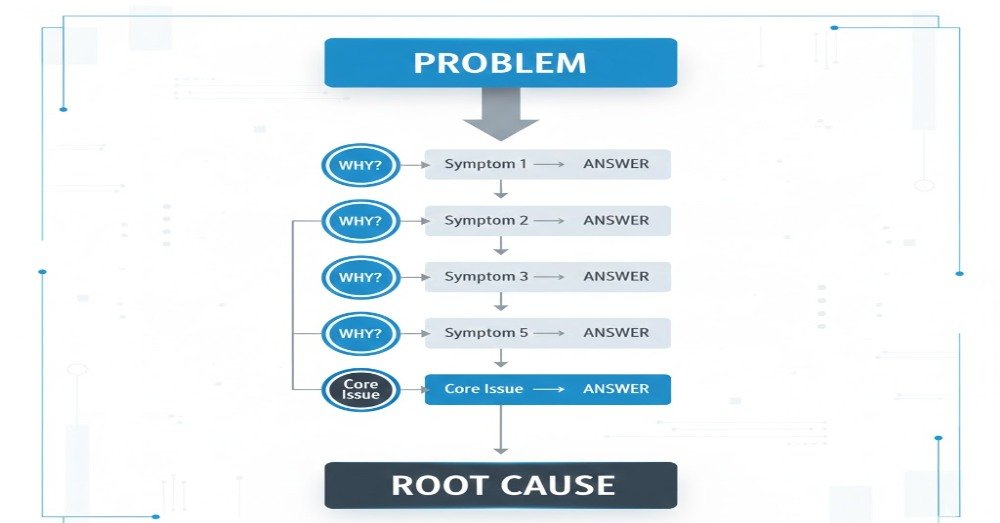
Originally developed by Sakichi Toyoda for Toyota, this exercise forces you to move past superficial symptoms to find the root cause of a problem.
How to do it:
- State a problem clearly (e.g., “I missed the project deadline”).
- Ask “Why?” (Answer: “Because I ran out of time”).
- Ask “Why?” again (Answer: “Because I started too late”).
- Ask “Why?” again (Answer: “Because I underestimated the task complexity”).
- Repeat until you hit the foundational issue (usually a process or belief failure).
2. Inversion Thinking (The Anti-Goal)
Time: 15 Minutes | Difficulty: Medium
Instead of asking how to achieve a positive outcome, ask how to guarantee a negative one. This “reverse engineering” often reveals risks you would otherwise miss.
How to do it:
- Goal: “How do I make this project a success?”
- Inversion: “What would I have to do to guarantee this project fails miserably?”
- List: Miss deadlines, ignore client feedback, hide errors, skip testing.
- Action: Now, create a plan to systematically avoid every item on that “failure list.”
3. The “Steel Man” Argument
Time: 20 Minutes | Difficulty: Hard
Most people “straw man” their opponents—attacking a weak version of their argument. Critical thinkers “steel man” them—building the strongest possible version of the opposing view before arguing against it.
How to do it:
Before disagreeing with a viewpoint (political, business, or personal), attempt to write down the opposing argument so well that the other person would say, “Yes, that is exactly what I mean.” Only then are you allowed to counter it.
4. The Socratic Soliloquy
Time: 5 Minutes | Difficulty: Easy
Use Socrates’ method of questioning on yourself to clarify your thinking.
The Questions:
- “What do I mean by this?” (Clarification)
- “What am I assuming?” (Assumptions)
- “What evidence do I have?” (Evidence)
- “What is an alternative explanation?” (Viewpoint)
- “What are the consequences of being wrong?” (Implication)
5. Cognitive Journaling
Time: Daily | Difficulty: Medium
We often forget why we made past decisions. A decision journal creates a feedback loop for your brain.
How to do it:
When making a significant decision, write down:
- The situation.
- The decision you made.
- The outcome you expect.
- The reasoning/data used.
- Six months later, review it. Were you right? If not, was it bad luck or bad process?
6. “Two Truths and a Lie” (Mental Edition)
Time: On the go | Difficulty: Easy
This isn’t the party game. It’s a filter for news and media consumption.
How to do it:
When reading a news article or business report, assume there is at least one significant error, omission, or misinterpretation (the “lie”). Actively hunt for it. Check sources, look for missing context, and spot logical fallacies.
7. Third-Person Visualization
Time: 5 Minutes | Difficulty: Easy
We are often emotionally attached to our own problems. Viewing them from a distance restores logic.
How to do it:
Describe your current problem as if it were happening to a friend. “John is struggling with…” instead of “I am struggling with…”. Studies show this simple linguistic shift reduces emotional reactivity and improves wise reasoning.
Part 2: 5 Team Critical Thinking Exercises
Groupthink is the enemy of intelligence. These exercises force teams to challenge consensus and think deeper.
8. The Pre-Mortem
Time: 45 Minutes | Difficulty: Medium
Unlike a post-mortem (which explains why a patient died), a pre-mortem simulates death before it happens.
How to do it:
- Gather the team before a project launches.
- The Prompt: “Imagine we are 6 months in the future. The project has failed completely. It was a total disaster.”
- The Task: Everyone has 5 minutes to write down why it failed.
- The Result: You now have a comprehensive list of risks that people were previously too polite to mention.
9. Six Thinking Hats (De Bono)
Time: 60 Minutes | Difficulty: Medium
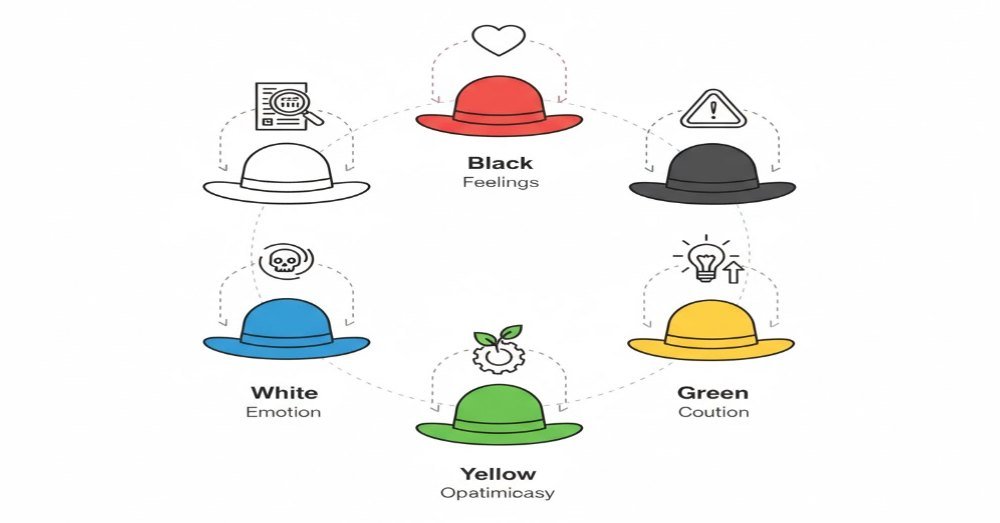
This framework separates thinking into six distinct modes, preventing messy debates where people argue from different angles (e.g., one person is being emotional while another is being analytical).
The Hats:
- White Hat: Facts and data only.
- Red Hat: Feelings and intuition (no justification needed).
- Black Hat: Risks, caution, and “why it won’t work.”
- Yellow Hat: Benefits, optimism, and value.
- Green Hat: Creativity and new ideas.
- Blue Hat: Process control (managing the meeting).
10. The “Devil’s Advocate” Rotation
Time: Ongoing | Difficulty: Easy
In many meetings, disagreement feels like conflict. This exercise formalizes dissent.
How to do it:
Assign one person the role of “Devil’s Advocate” for the meeting. Their specific job is to poke holes in every idea, question assumptions, and find flaws. Because it is a role, it doesn’t feel personal. Rotate this role every meeting.
11. Silent Brainstorming
Time: 15 Minutes | Difficulty: Easy
In verbal brainstorming, the loudest voices dominate. Silent brainstorming (or “Brainwriting”) equalizes the playing field.
How to do it:
- State the problem.
- Everyone writes ideas on sticky notes silently for 5-10 minutes.
- Post all notes on the wall.
- Discuss/vote after all ideas are visible.
This separates the idea from the person, allowing for objective critique.
12. The Ladder of Inference
Time: 30 Minutes | Difficulty: Hard
This exercise helps teams understand how they jump to conclusions.
The Steps:
- Data: What are the objective facts?
- Selection: What data did we focus on?
- Interpretation: What does this mean?
- Assumptions: What are we taking for granted?
- Beliefs: What are our conclusions?
- Actions: What are we doing?
When the team disagrees, walk down the ladder. “Wait, are we arguing about the action, or do we disagree on the underlying data?”
Comparison: Reactive vs. Critical Thinking
Understanding the difference is the first step to improvement.
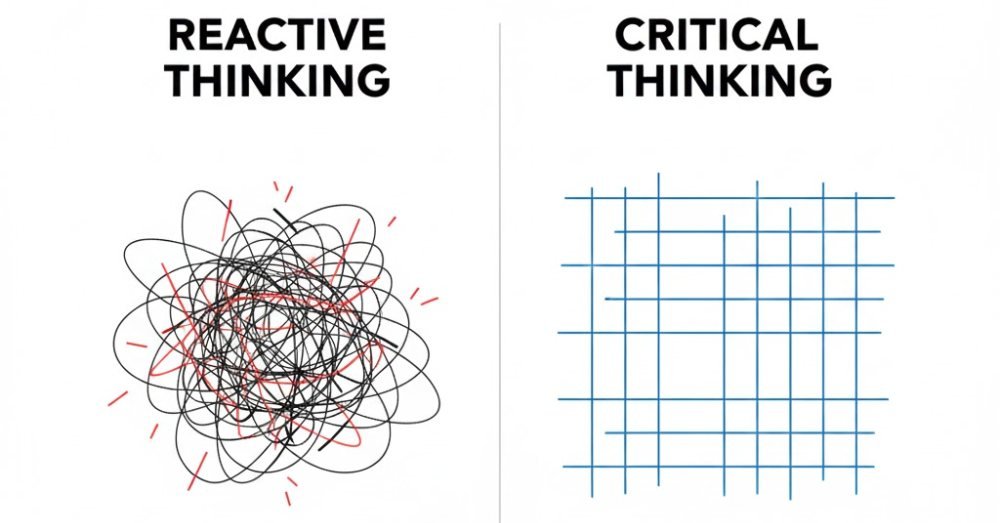
| Feature | Reactive Thinking | Critical Thinking |
|---|---|---|
| Speed | Fast, automatic (System 1) | Slow, deliberate (System 2) |
| Driver | Emotion, habit, bias | Evidence, logic, curiosity |
| Reaction to New Info | Defensiveness (“I’m right”) | Curiosity (“Tell me more”) |
| Goal | Winning the argument | Finding the truth |
| Outcome | Repetitive mistakes | Better decisions over time |
3 Hidden Barriers to Critical Thinking
Even with the best exercises, these biological barriers can get in the way.
1. Confirmation Bias: The tendency to search for, interpret, and recall information in a way that confirms our pre-existing beliefs. Fix: Use the “Steel Man” exercise.
2. Sunk Cost Fallacy: The reluctance to abandon a course of action because heavily invested in it, even when it is clear that abandonment would be more beneficial. Fix: Use the “Zero-Based Thinking” rule (If I hadn’t started this yet, would I start it today?).
3. Authority Bias: Over-valuing the opinion of an authority figure (boss, expert) and suspending your own judgment. Fix: Use Silent Brainstorming to hide hierarchy.
Best Practices for Implementing These Exercises
- Start Small: Do not try all 15 at once. Pick one individual exercise (like Cognitive Journaling) and one team exercise (like the Pre-Mortem).
- Create Psychological Safety: Critical thinking requires honesty. If people are punished for questioning the status quo, they will stop doing it.
- Make It a Ritual: Make “The Pre-Mortem” a standard part of every project kickoff. Make “5 Whys” the standard response to every error. Consistency creates culture.
Conclusion
In a world of deepfakes, algorithmic feeds, and rapid change, your ability to think critically is the only thing protecting you from being misled.
By engaging in these critical thinking exercises, you move from being a passive consumer of information to an active analyst of reality. You make better decisions, solve more expensive problems, and lead more effective teams.
Pick one exercise from this list today. Challenge an assumption. Ask “Why?” five times. Invert the problem. The upgrade to your mind starts now.
FAQ
Q: Can critical thinking really be taught?
A: Yes. While IQ is largely fixed, critical thinking exercises is a skill—a method of processing information. Like learning to code or write, it improves with study and practice.
Q: How long does it take to see results?
A: You can see immediate results in a single meeting by using a tool like the “Pre-Mortem.” Long-term cognitive changes (like reduced bias) typically take 3-6 months of consistent practice.
Q: Is critical thinking the same as creative thinking?
A: No, but they are related. Creative thinking is generative (creating new ideas), while critical thinking is analytical (evaluating ideas). The best thinkers switch between both modes (e.g., using the Green Hat for creativity and Black Hat for critique).